Shifting Landscape

Change is often considered positive

but not necessarily so for the banking and financial sector. Any drastic event acts as a threat, as banks and financial institutions are the first to get impacted. The impact may include a rise in fraudulent activities such as an increase in fraudulent loans, higher delinquency rates, and impacting credit portfolios breaching normal risk appetite. If a bank is not adequately prepared, such changes can disrupt normal lending operations, damage its reputation, and even result in regulatory penalties.

To mitigate such threats, RBI released Directions on Fraud Risk Management , introducing EWS framework to identify emerging risks before they escalate. EWS will allow BFSI to strengthen by minimizing the risk at the origination as well as identify potential RFA (Red Flagged accounts) during the account management stage, stretching internal controls and minimizing the incidences of fraud.

What are Early Warning Signals in Banking?

Early warning signals are the indicators that point to potential problems or risks, helping to maintain financial stability. These signals in a loan account should immediately put the bank on alert regarding a weakness or wrongdoing which may ultimately turn out to be fraudulent. We will be discussing these signals in more detail, starting with types of signals and RBI-suggested indicators. Before this, let’s discuss what is the importance of these indicators.

Lehman Brothers Collapse

  • The 2008 bankruptcy was preceded by client migrations, asset devaluation, and extreme stock losses. These signs went unnoticed or underappreciated until the crisis began to unfold. This collapse was also intricately linked to the subprime mortgage crisis.
Yes bank Crisis
  • In 2020, Yes Bank collapsed due to a surge in non-performing assets (NPAs). Aggressive lending practices, high-risk loans, and underreporting of NPAs contributed to its financial instability, ultimately leading to regulatory intervention and a moratorium.

The relatively smaller signals preceding the looming crisis allow banks to act before risks spiral out of control.

Types of Early Warning Signals
Early warning signals can be categorized into two main types: financial indicators and non-financial indicators. Each signal category provides different insights that, when combined, offer a comprehensive view of potential risks.

  • Financial Indicators: Quantitative in nature and centred around financial health, such as delinquency rates, income statement, balance sheet, cash flow, and financial ratios such as liquidity ratios, debt-to-equity ratio, and interest coverage ratio.
  • Non-financial Indicators: These are not quantifiable but, related to sentimental value, have a huge impact on business performance. Example: industry trends, management change, adverse news, and so on.
  • Custom /Internal Indicators: these are internal metrics developed by the organisation for themselves using various parameters. These can be based on customers historical data, customer payment behaviors, credit scores, loan history, payment-balance ratio, and more

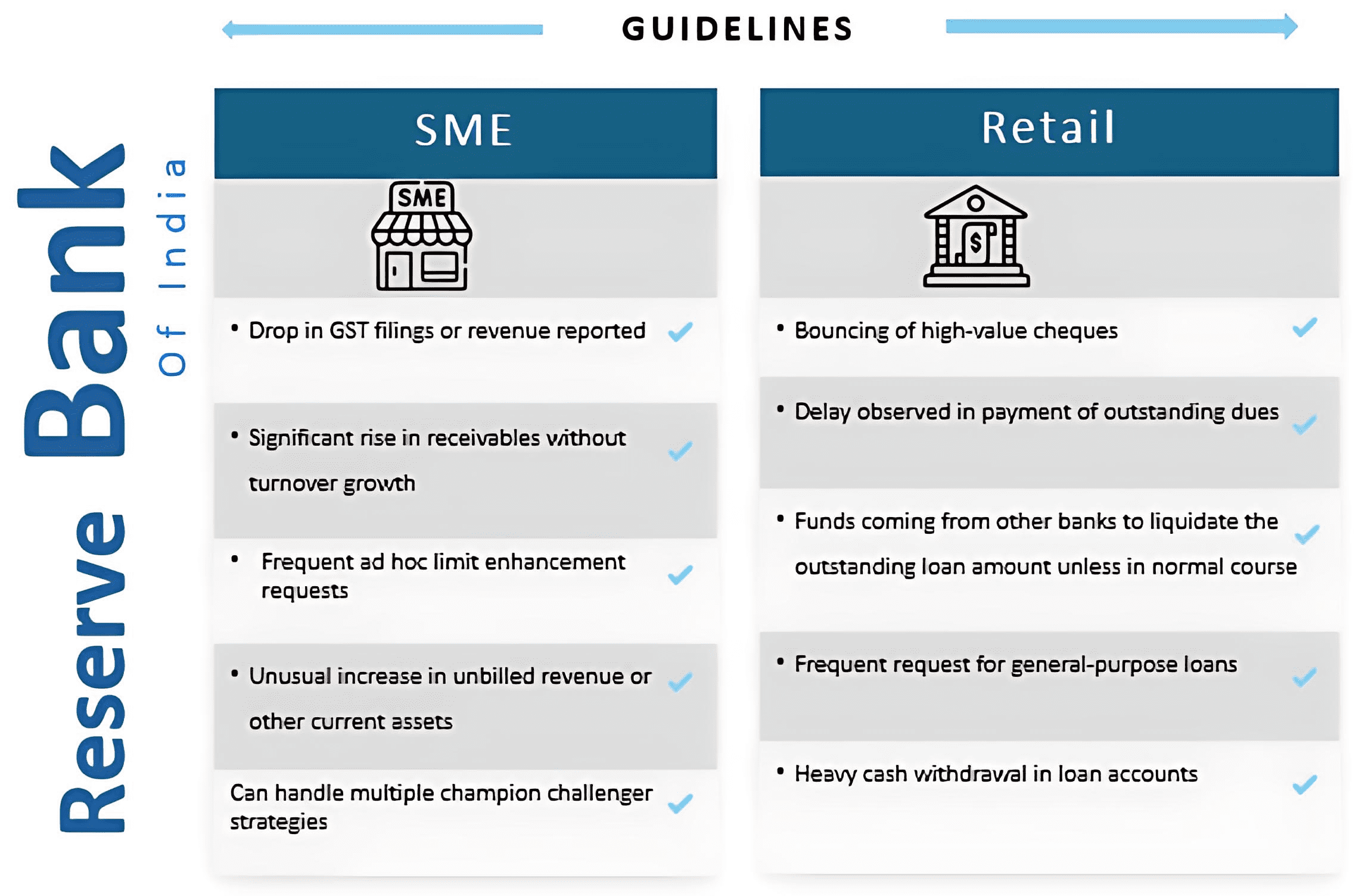
Signals Suggested by RBI

Now as we have a basic understanding of early warning signals, we will be discussing the latest EWS framework, guidelines, and how these signals are used to identify risk in our upcoming blogs.

Now that we’ve developed the basic risk indicators, let’s delve into what early warning systems are.

What is an Early Warning System?


An Early Warning System (EWS) is a robust and effective credit monitoring mechanism for the entire lifecycle of loan accounts. EWS utilizes risk signals and raises alerts for Red Flagged Accounts (RFA), i.e., accounts with a high suspicion of fraudulent activity. Critically, an EWS aims to detect weaknesses that may have escaped during the appraisal stage and alert before they become catastrophic failures.

To explain better, consider the working of a bank that uses deposits to lend loans — usually for longer periods — creating a maturity mismatch that makes them vulnerable to liquidity risks. Under normal operations, such liquidity is accounted for by banks, but if due to a certain event, this liquidity risk can widen, it can trigger a domino effect where banks stop lending, overall market liquidity shrinks, and institutions are forced to sell assets at depreciated values. This vicious cycle can severely compromise banks’ loan portfolios as non-performing loans surge. An effective EWS keeps an eye on these liquidity indicators and flags when the market environment is shifting toward higher risk.

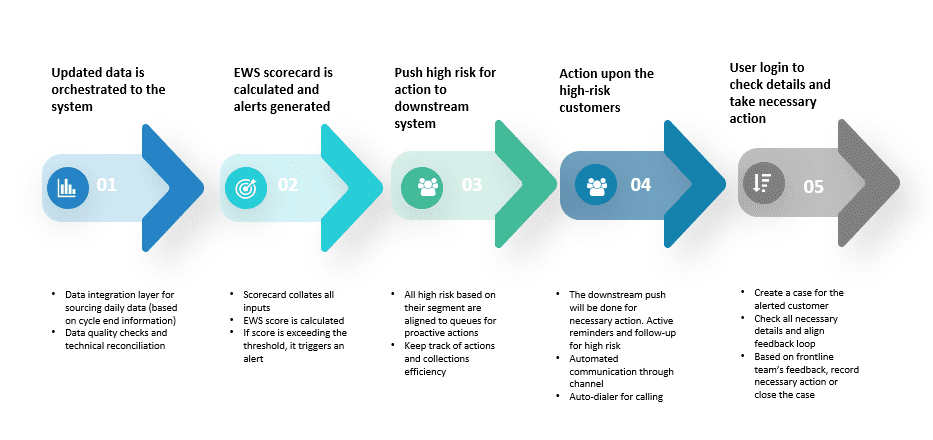
Working Overview of EWS

Early Warning System is aimed to help organisations make risk strategies that minimize risk. A well-implemented EWS not only reduces delinquency but also helps reduce costs during onboarding by flagging risks and optimizing modes for credit recovery without impacting customer experience.

Following is the general process flow diagram for EWS.

Our Value Proposition

What makes Sutra’s Early Warning Signal (EWS) solution truly stand out is its versatility and depth—designed to address the needs of all lending institutions, across customer segments and loan types.

Whether you’re dealing with secured or unsecured loans, working with retail borrowers, SMEs, corporates, or microfinance customers, our platform adapts to your risk environment. It comes with a comprehensive library of out-of-the-box rules—including RBI-specified risk indicators—that can be easily configured by business users through a low-code, no-code interface. This means risk teams can make changes swiftly, without relying on IT or developer resources.

The solution integrates structured and unstructured data from both internal systems (loan, payment, CRM) and external sources (credit bureau, GST, adverse media), powered by robust data pipelines that ensure consistency and traceability.

High-risk alerts are not just generated—they’re investigated. The platform includes built-in workflows for case creation, assignment, and resolution, helping organizations take timely action, document follow-ups, and strengthen audit readiness.

And the best part? All of this comes in one unified platform—analytics, scoring, alerts, dashboards, and case management—offering scalability, simplicity, and speed.

Value Beyond Compliance

  • Aligns with RBI’s regulatory mandates, including the July 2024 circular on EWS implementation.
  • Enhances collections efficiency by prioritizing risk-based actions.
  • Improves portfolio health through early intervention.
  • Reduces operational costs by automating decisions and streamlining workflows.
  • Allows quick adoption across departments with its user-friendly interface.
  • Prepares institutions for the future with modular, scalable architecture.

Conclusion

In today’s dynamic and increasingly regulated lending environment, having a proactive and intelligent EWS framework is no longer optional—it’s essential. From detecting early signs of borrower stress to enabling timely corrective action, a well-designed EWS system helps financial institutions protect their portfolios, meet compliance expectations, and build long-term resilience.

At Sutra, we believe that the future of credit risk management lies in speed, transparency, and adaptability—and our EWS solution is built to deliver exactly that.

Leave A Comment